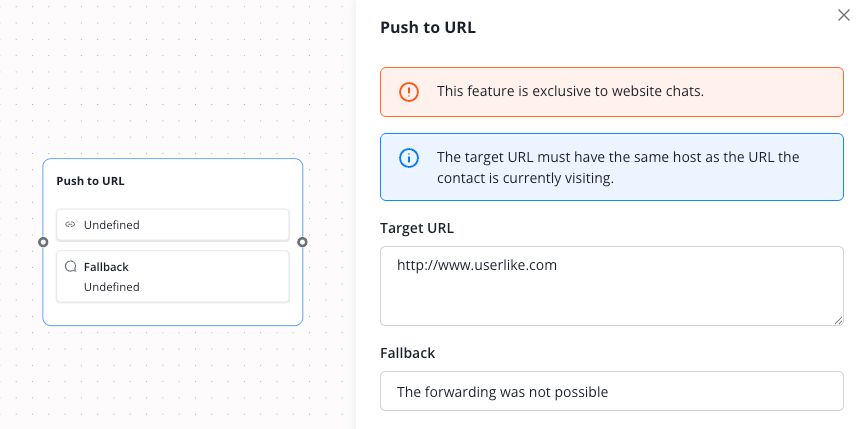
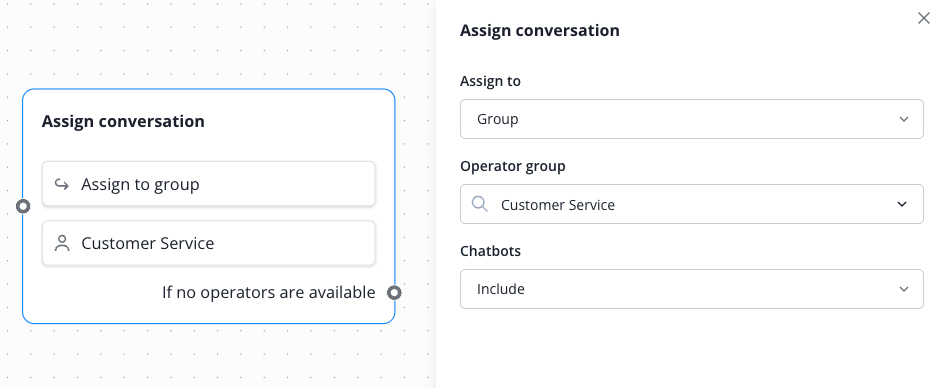
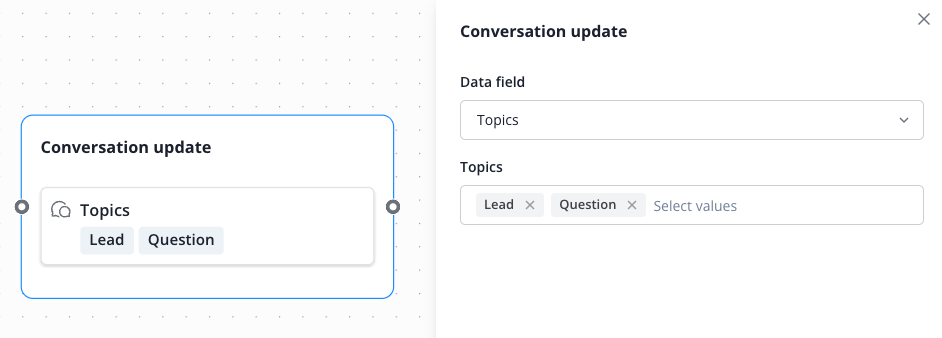
You can enlarge all screenshots by clicking on them. The screenshots show the node itself as well as the corresponding settings menu.
Assign conversation
Use this node to forward the conversation to a specific operator, operator group, or skill.
In our example: The conversation is forwarded with all previous messages to an operator from the "Customer Service" group, potentially including any chatbots that exist in this group.
Conversation update
Use this node when you want to change the language, subject, or topics of the current conversation.
In our example: The topics of the current conversation are set to "Lead" and "Question".
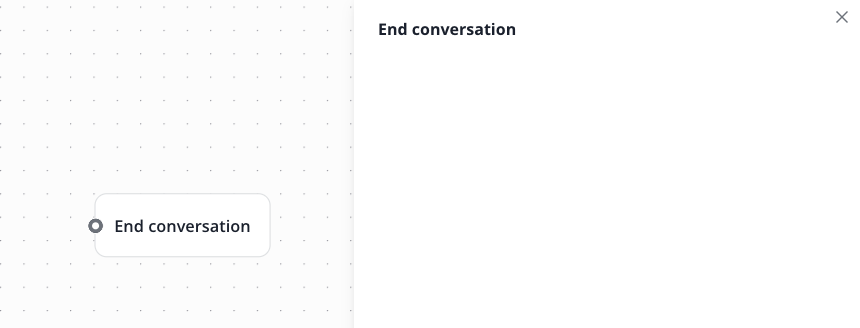
End conversation
Use this node when the chatbot should end the conversation.
In our example: When this node is reached, the chat is ended.
Send transcript
Use this node when you want to send the conversation transcript by email. Under "Send to" you decide who receives it: "Contact" sends it to the contact, and "Operator" sends it to the addresses you enter in the "Recipients" field. That field appears only for "Operator", and switching back to "Contact" empties it.
The two transcripts are not the same. The one sent to the recipients under "Operator" also includes the conversation's internal notes, and that holds for every address in the field. The one sent to the contact does not include them. So check who is in the field before you activate the workflow.
Under "Recipients", pick an operator from the dropdown, or type any email address. Confirm a typed address with the Enter key, a space, a comma or a semicolon; clicking away from the field also confirms it. A recipient does not have to be an operator in Lime Connect, so a transcript can also reach a department mailbox or an address outside your team. An entry that is not an email address is not accepted.
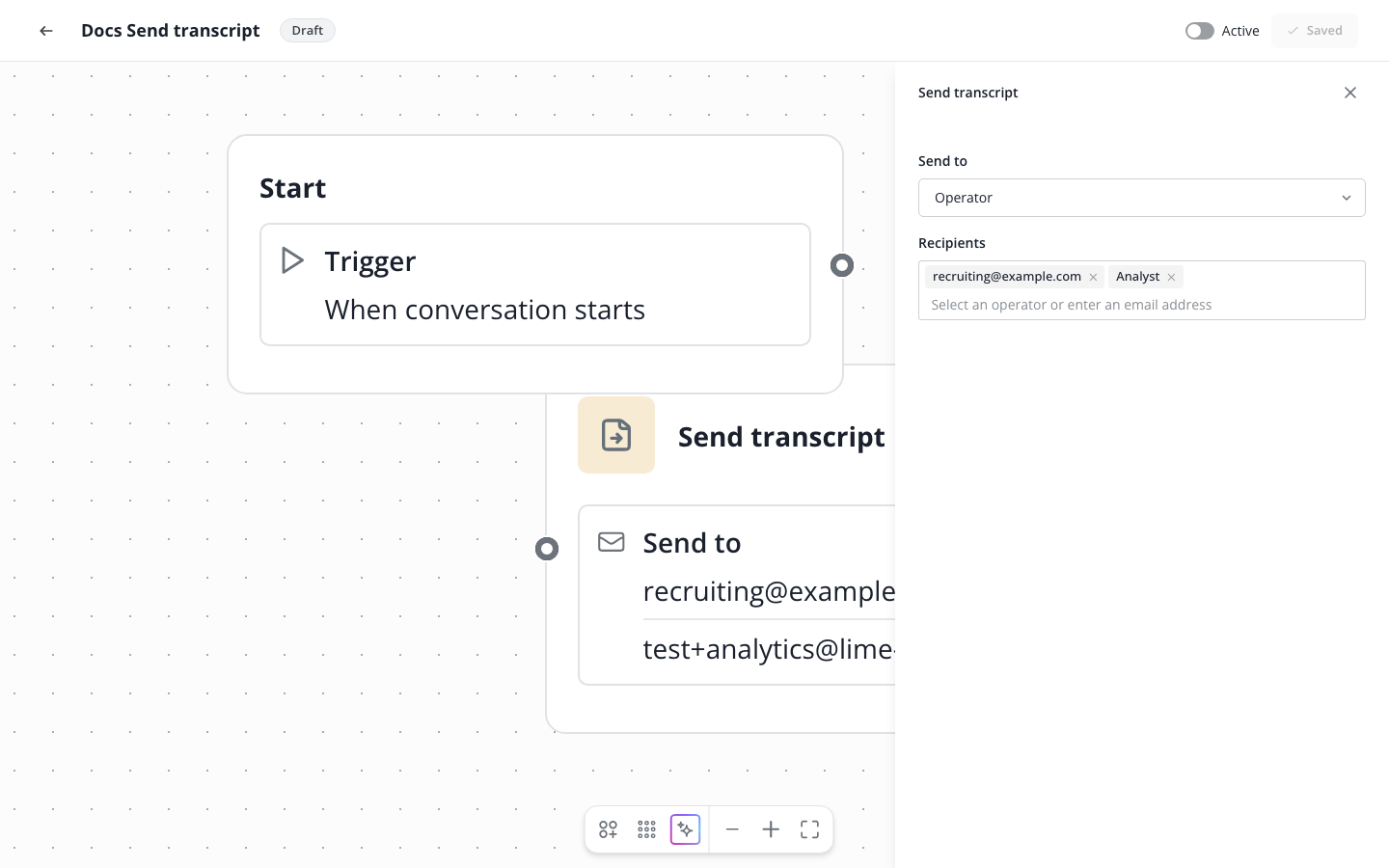
In our example: The transcript goes to one operator and to one address entered by hand, and is sent by email at the end of the conversation.
Sending a WhatsApp Template
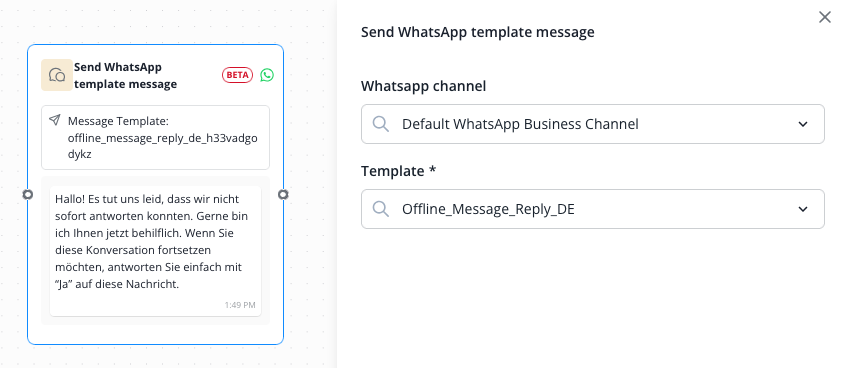
Use this node if you want to send a WhatsApp template to your contact.
Select your desired WhatsApp channel and the template.
Contact update
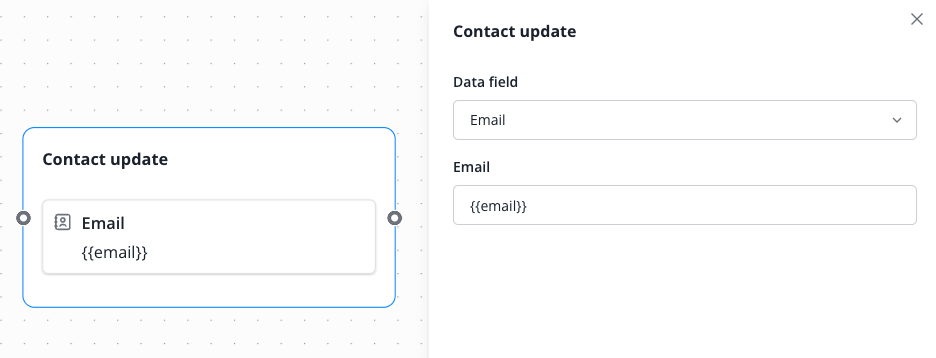
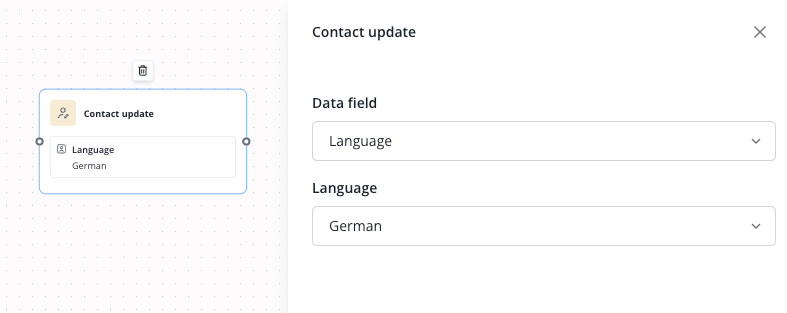
Use this node to change or add data to the contact's profile in Lime Connect. You can use name, email address, customer ID, mobile number, language, and custom data fields. For Name, Email and Mobile number, select a variable that holds the new value, or switch on Clear field to remove the value from the contact. For Customer ID and custom fields, you can enter a fixed value or work with data previously requested by the chatbot and stored in a variable. For this, use double curly braces {{ }}. A custom field with a list of options offers those options instead. For Language, choose one of the available languages from the list; a variable is not possible here. This sets the language of the contact, not of the conversation. To change the language of the conversation, use the "Conversation update" node. In our example: The contact's email address is filled or updated with the content of the "email" variable.
Campaign subscriptions
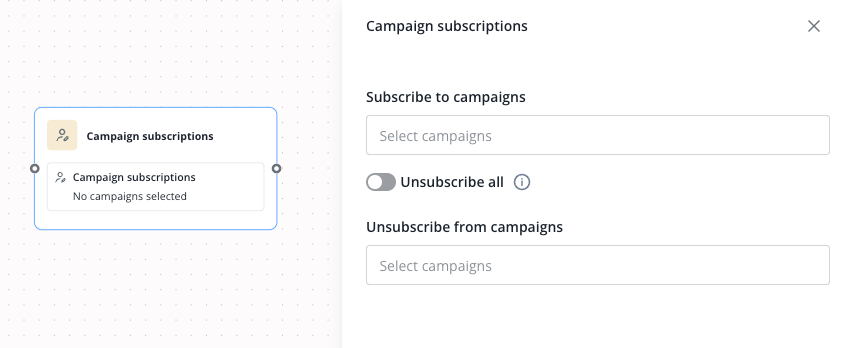
Use this node when you want to subscribe the contact to WhatsApp campaigns or unsubscribe them from campaigns. Under Subscribe to campaigns, select the campaigns the contact should be subscribed to. Under Unsubscribe from campaigns, select the campaigns the contact should be removed from. To remove all existing subscriptions of the contact first, switch on Unsubscribe all; the field Unsubscribe from campaigns then disappears, and the campaigns under Subscribe to campaigns are added afterwards.
Create note
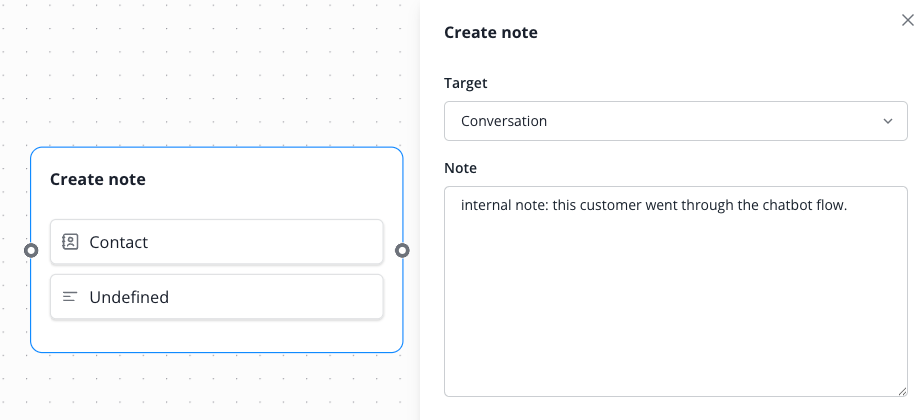
Use this node when you want to add an internal contact or conversation note. This will then be displayed in the Message Center after the conversation.
In our example: An internal note with the specified text is created within the conversation.
Push to URL
Use this node when you want to automatically direct the contact to a URL within your website. Directing the contact to the URL only works in web chats. The URL must have the same host as the page the contact is currently visiting; another subdomain does not count. In our example: The contact is directed to the specified target URL. In a channel, the contact receives the fallback message instead. In the web chat, a target URL on another host is not opened and no fallback message is shown.