
You can enlarge all screenshots by clicking on them. The screenshots show the node itself as well as the corresponding settings menu.
API request
Use this node to exchange data with external systems via API requests. Use GET, POST, PUT or DELETE as methods. You can also add headers and body. Save the result of the query in a variable for later use in the conversation.
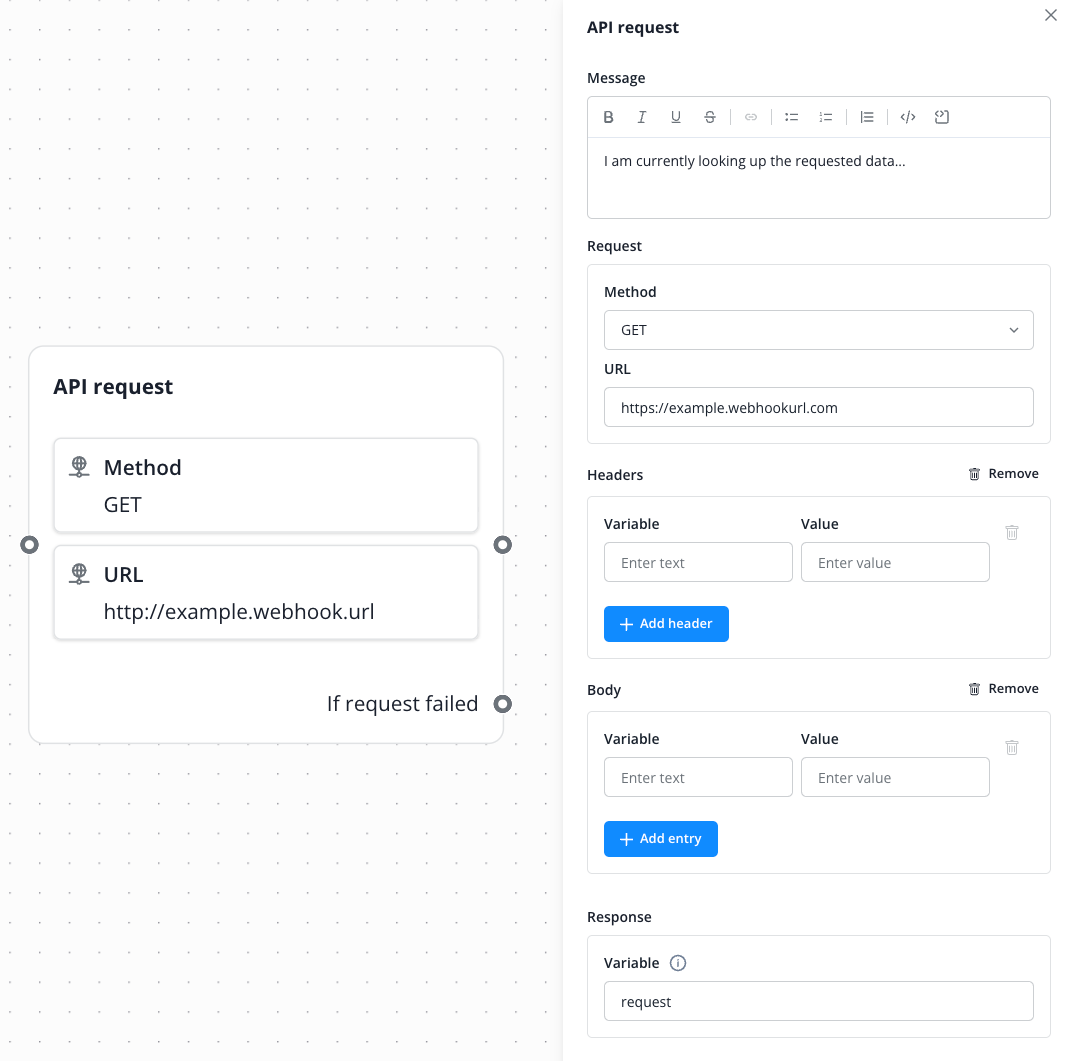
Instead of a body, you can also send a file to the external system, for example a file the contact sent earlier through the "Capture media" node (described below). To do so, click on "Add file".
A request sends either a body or a file, never both: the file replaces the body. If "Add file" is unavailable, the node already has a body. Remove the body first, then add the file.
Under "File upload type", choose how the file is transferred:
- Form data with file: Choose this when the external system expects a file upload like one from a web form. The file is sent as one field of the form. Under "Field name" you set what that field is called. If you do not enter a name, the field is called "file".
- Raw file content: Choose this when the external system expects the file itself as the body of the request. The file type is sent along with it.
Under "File", enter the link to an external file, or click on "Insert variable" in the field and select the variable in which the "Capture media" node stored the file. This is the same variable picker as in the other fields of the workflow. If the file cannot be retrieved when the workflow runs, for example because the variable is empty, the request is not sent and the workflow follows the "If request failed" exit.
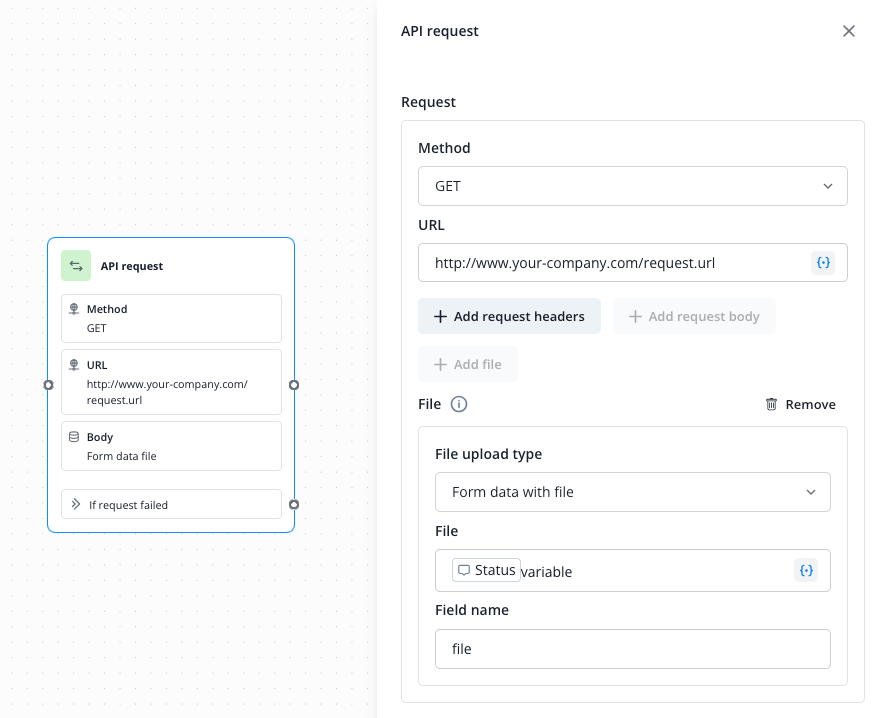
The node's "Body" area on the workflow canvas then shows what is sent: "JSON Body", "Form data file" or "Raw file".
Capture carousel
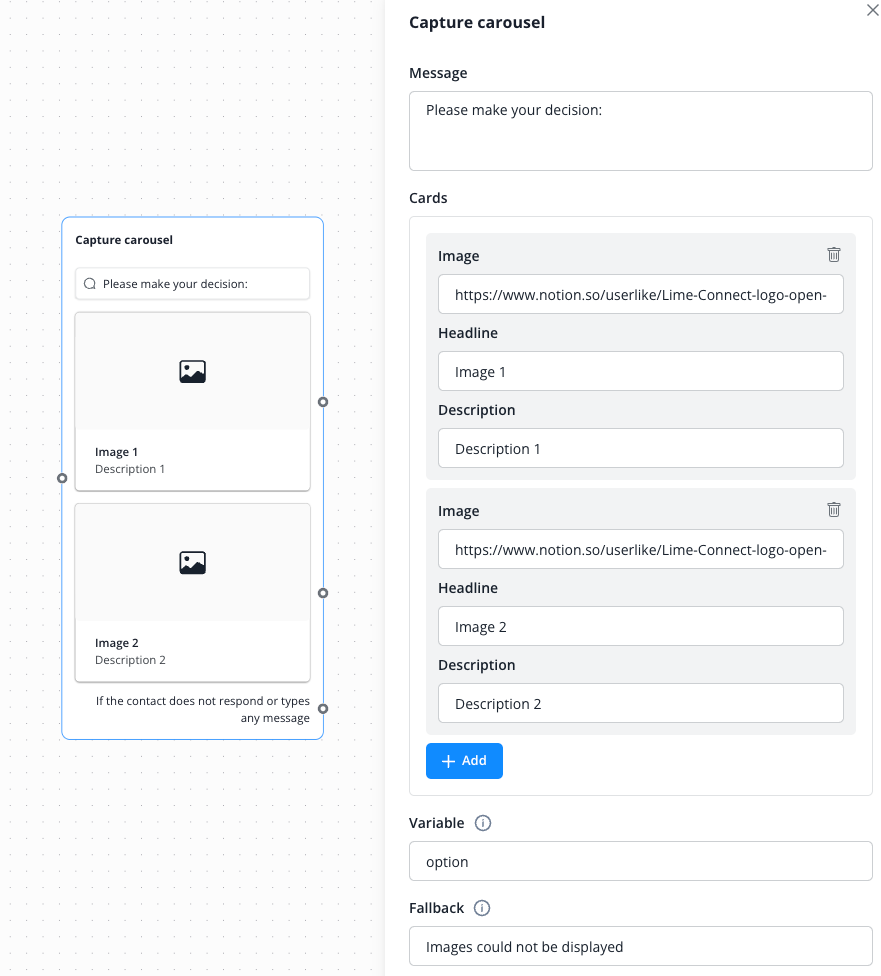
Use this node when you want to let the contact choose from a predefined number of options (including image and description) and temporarily save it in a variable for later use in the conversation. Use a fallback text in case the options cannot be displayed.
In our example: The contact is asked to choose from three options. The contact's selection is temporarily stored in the "option" variable. If the buttons cannot be displayed, the fallback text will be played.
Capture regex
Use this node when you want to check the customer's input against a specific, predefined format. You can find some examples by expanding the following point:
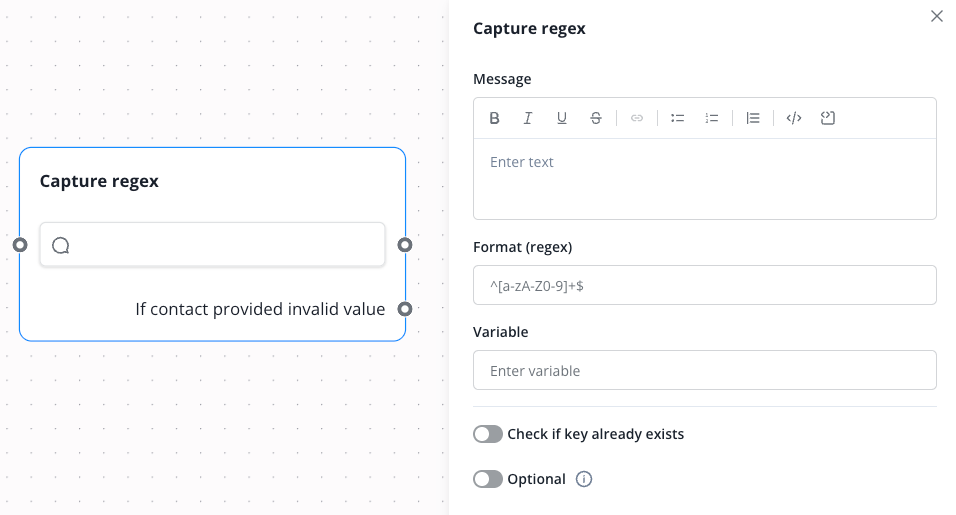
Regex Examples:
Capture buttons
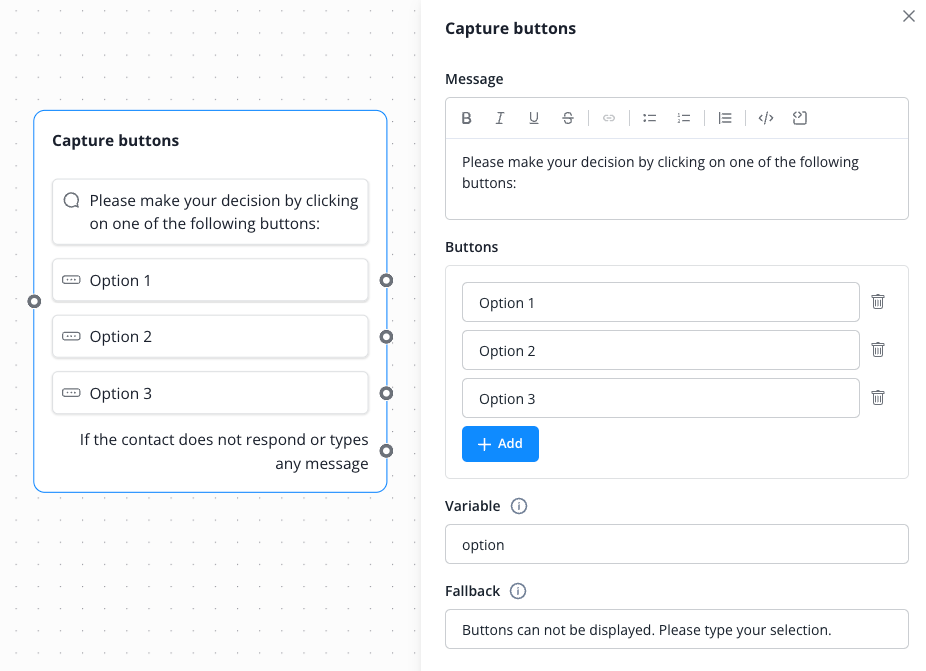
Use this node when you want to let the contact choose from a predefined number of options and temporarily save it in a variable for later use in the conversation. Use a fallback text in case the buttons cannot be displayed.
In our example: The contact is asked to choose from three options. The contact's selection is temporarily stored in the "option" variable. If the buttons cannot be displayed, the fallback text will be played.
Capture email
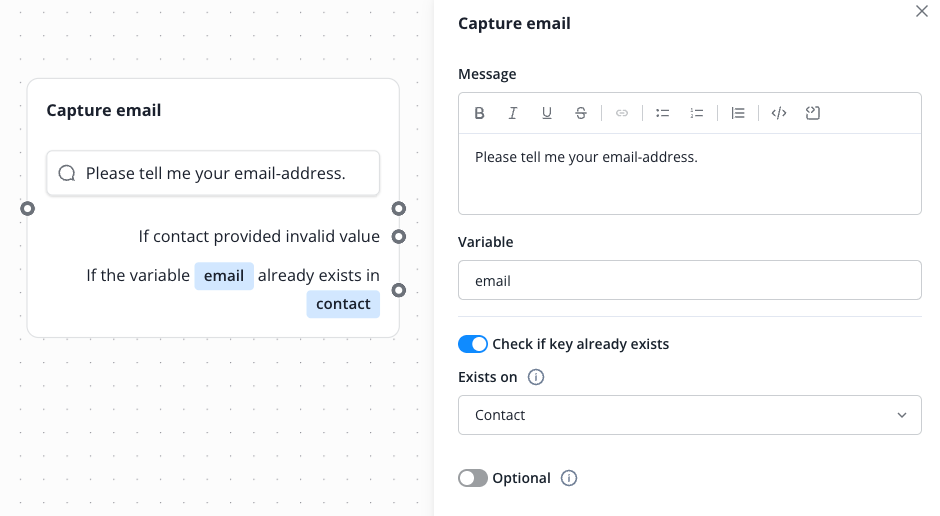
Use this node when you want to request the contact's email address and temporarily save it in a variable for later use in the conversation. Decide whether you want to check if the variable already contains data, and whether you want to give the contact the option to skip the input.
In our example: The contact is asked to enter their email address. The contact's input is temporarily stored in the "email" variable. The system checks whether the variable already exists and is filled within the contact fields. The contact cannot skip the input.
Capture media
Use this node when you want to want the contact to send a document within a workflow. Choose the document type (Image, Video, Audio, Document or any).
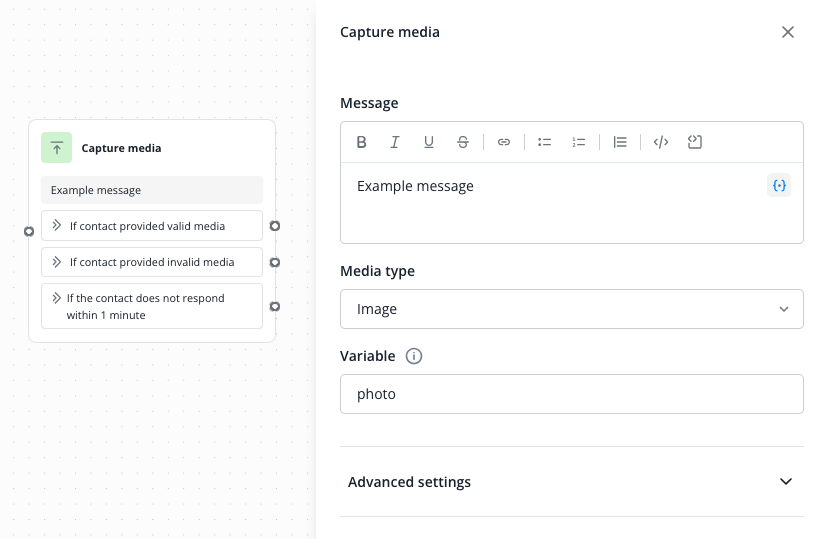
In our example: The contact is asked to provide a document of type Image.
Use this node when you want to want the contact to send a document within a workflow. Choose the document type (Image, Video, Audio, Document or any).
If you want to use the file later in the workflow, enter a name under "Variable", for example "photo". The node then stores a link to the captured file in that variable. This is optional.
You can then use the variable in two nodes. In both fields you insert it with "Insert variable", where you find it under "This Workflow":
- Message: Click on "Add media" and insert the variable into the "URL" field to send the file to the contact again. The "Message" node is described under [General nodes](https://docs.lime-connect.com/general-nodes-2c482b4dcc478116a022c5e7f0dda78e).
- API request: Insert the variable under "File" to send the file to an external system (see the "API request" section above).
In our example: The contact is asked to provide a document of type Image.
The image is stored in the "photo" variable, so it can be sent again or passed on later in the workflow.
Capture text
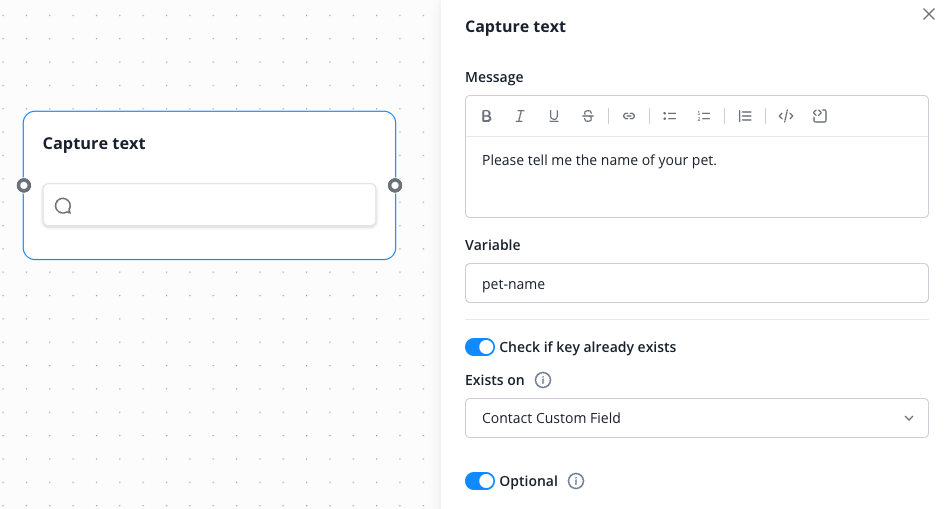
Use this node when you want to request any text from the contact and temporarily save it in a variable for later use in the conversation. Decide whether you want to check if the variable already contains data, and whether you want to give the contact the option to skip the input.
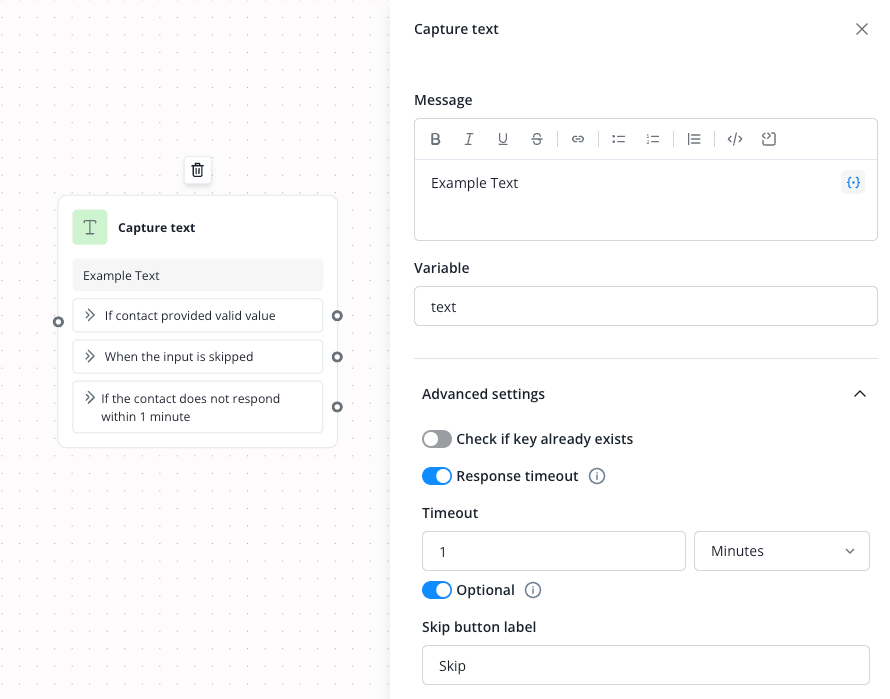
In our example: The contact is asked to enter the name of their pet. The contact's input is temporarily stored in the "pet-name" variable. The system checks whether the variable already exists and is filled within the custom contact fields. The contact can skip the input.
Capture text, Capture email, Capture regex and Capture media share the same skip setting. Turn on "Optional" to let contacts skip the step. Under "Skip button label", enter the text of the button, for example "Skip". The label can have up to 20 characters, and "Skip" is filled in when you turn on "Optional".
The contact then sees the button below your message and skips the step by clicking on it. The workflow follows the "When the input is skipped" exit. If you leave "Skip button label" empty, no button is shown and contacts can only skip by typing a skip keyword, if your workflow has skip keywords.
The button is shown in the Website Messenger, WhatsApp and Facebook Messenger. In all other channels, the contact sees only your message and can only skip by typing a skip keyword. Typing a keyword also skips the step when the button is shown. Any other text, including "1", is treated as the answer to the question.
WhatsApp list
Use this node to enable your contacts to make a selection from a predefined list of options within WhatsApp channels. This can display up to 10 options in a list format.
WhatsApp quick response
This node is used analogously to the "Capture buttons" node when you want to use the chatbot in WhatsApp channels. This can display up to 3 buttons/options.
What happens when a contact answers with a voice message?
A contact can also answer a waiting node with a voice message or an audio file. Lime Connect transcribes the recording, and the workflow uses the text as if the contact had typed it. Transcription is on in every organization unless it was switched off. How to switch it off, and how much audio is transcribed per day, is described in the "Voice messages" section of the Message Center.
How each node handles the text of a voice message:
- Capture text, Capture email and Capture regex: The text is checked like a typed answer. If it is valid, the workflow follows "If contact provided valid value" and stores the text in the node's variable. If it is not, the workflow follows "If contact provided invalid value". This happens, for example, when the contact says an email address aloud and the text reads "name at example dot com" instead of "name@example.com".
- Capture buttons, Capture carousel, WhatsApp list and WhatsApp quick response: A voice message never selects an option, even if the contact says its name. The workflow follows "If the contact does not respond or types any message".
- Capture media: The text is not used and cannot skip this node. The recording itself counts as a file: the workflow follows "If contact provided valid media" if the node accepts audio files, and "If contact provided invalid media" if it only accepts another file type.
If a recording cannot be transcribed, for example because transcription failed or the daily allowance is used up, Capture text, Capture email and Capture regex follow "If contact provided invalid value" and store nothing. If that exit is not connected, the node keeps waiting. The nodes with options always keep waiting. If transcription is switched off for your organization, a voice message does not answer these nodes at all and the node keeps waiting.
The text only answers a node that was already waiting when the contact sent the voice message. If the workflow has moved on in the meantime, for example because the contact typed an answer before the transcript was ready, the text of the voice message is not used.